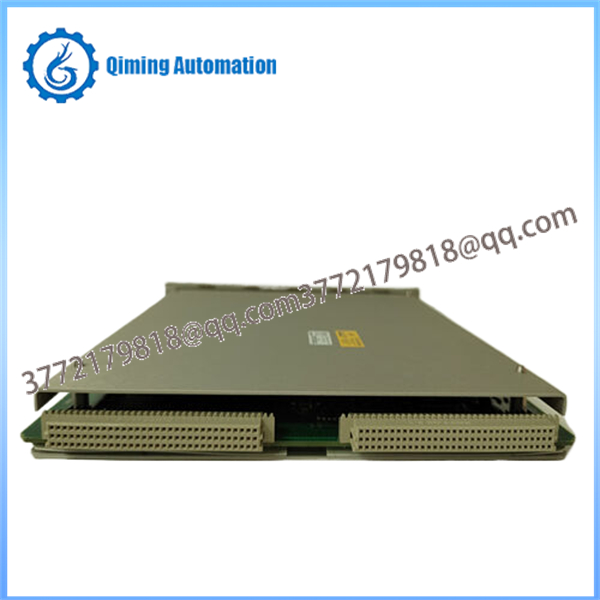





Bently Nevada 135031-01 is a rack interface I/O module in the Bently Nevada 3500 system, mainly used for vibration monitoring and signal management of industrial rotating equipment. It connects sensors and systems to ensure real-time data transmission and supports both analog and digital signals.
_副本.jpg)
_副本.jpg)
There are still some products that have not been listed yet. For more information, please contact us. If the product model does not match the displayed picture, the actual model shall prevail. Please consult us for specific product images; We will arrange for the warehouse to take photos for confirmation. We have 76 shared warehouses worldwide, so it may take several hours to accurately respond to your message. We deeply apologize for any inconvenience caused to you. Of course, we will process your inquiry as soon as possible.
Bently Nevada 135031-01 is a rack interface I/O module in the Bently Nevada 3500 system, mainly used for vibration monitoring and signal management of industrial rotating equipment. It connects sensors and systems to ensure real-time data transmission and supports both analog and digital signals.
_副本.jpg "135031-01")
The working temperature range of this module is -30 ° C to+65 ° C, the storage temperature is -40 ° C to+85 ° C, and the size is approximately 241.3 x 24.4 x 99.1 mm.
Compatible with external communication processors such as TDXnet and TDIX, suitable for equipment protection in industries such as oil and gas, power generation, etc.
Manufacturer Bently Nevada
Type Rack Interface I/O Module
Working temperature -30 to+65 ° C
Storage temperature -40 to+85 ° C
Dimensions (HxWxD) 241.3 x 24.4 x 99.1 mm
_%E5%89%AF%E6%9C%AC.jpg "135031-01")
Used for condition monitoring of rotating machinery such as turbines, compressors, pumps, etc., managing input and output signals, and preventing fault shutdowns.
Supports remote communication via modem interface to enhance system reliability, often integrated with the 3500/20 series.
1.1.1 Research Background
In recent years, with the development of national industrial science and technology, the demand for non-contact measurement applications has become increasingly evident. Non contact measuring devices such as measuring displacement and vibration, as well as safe operating conditions, are increasingly being valued. By using the principle of eddy current effect for non-contact measurement of displacement, vibration, etc., eddy current detection has a series of advantages, such as good linearity and no interference from non-conductive media. Therefore, in recent years, non-contact measurement of eddy current has been widely applied.
The first combination of eddy current effect and measurement method was proposed by D.E. Hughes in his experiment in 1879. It was not until the 1940s and 1950s that a testing method and technology began to form, as the Rentique Institute in Germany and Bently Nevada in the United States continued to study the basic principles of eddy current sensors. Subsequently, related products and equipment based on the principle of eddy current appeared. The current application of eddy current equipment can be divided into two aspects. One part is used in monitoring and protection systems, where high technical indicators such as linear measurement range, reliability, and stability of eddy current sensor equipment are required. The other part is used in testing instruments, where high technical indicators such as accuracy, linearity, and resolution are required. With the development of industrial production and the improvement of related scientific and technological levels, the requirements for testing instruments are becoming increasingly high. Capacitive sensors have been used in many occasions in the past. The fatal weakness of capacitive sensors is that the measurement data results are easily affected by changes in the medium between the sensor itself and the measured conductor, and the installation conditions of the sensor are harsh, which limits the practical application of such sensors. This article uses PSoC chip as the sensor core, and proposes a solution 4 to further improve sensor accuracy based on eddy current sensor technology, including linearization processing methods and methods to improve sensor stability.
Do you provide global shipping services?
Yes. We have local distribution centers on all continents, which can quickly transport parts to any corner of the world.
2. What payment methods and currencies do you accept?
To make your purchasing process as simple as possible, we offer multiple payment methods including bank transfer, check, and PayPal. Meanwhile, we also accept most mainstream credit and debit cards, such as Visa, Mastercard, and American Express. We can accept payments in most major currencies worldwide, but we recommend using US dollars (USD), British pounds (GBP), or euros (EUR) as a priority. Payments in other currencies may incur additional fees. All transactions are securely processed by HSBC Bank and HSBC Merchant Services.
How many parts do you currently have in stock?
We have a vast inventory of thousands of new, refurbished, and outdated automation components, including products from well-known manufacturers such as ABB and Schneider. If you cannot find the required parts, please do not worry. We work closely with a global network of professional suppliers to provide you with tailored quotes even if the part is not listed on our website.
Who can I contact if I encounter any problems?
Our experienced customer service team will handle any issues after you place your order.


 WhatsApp
 WeChat
Copyright © 2026 Guangzhou Qiming Automation Technology Co., Ltd


 TOP
TOP Home
Home Consult Now
 Back to list
_副本.jpg)
_副本.jpg)
_副本.jpg)