





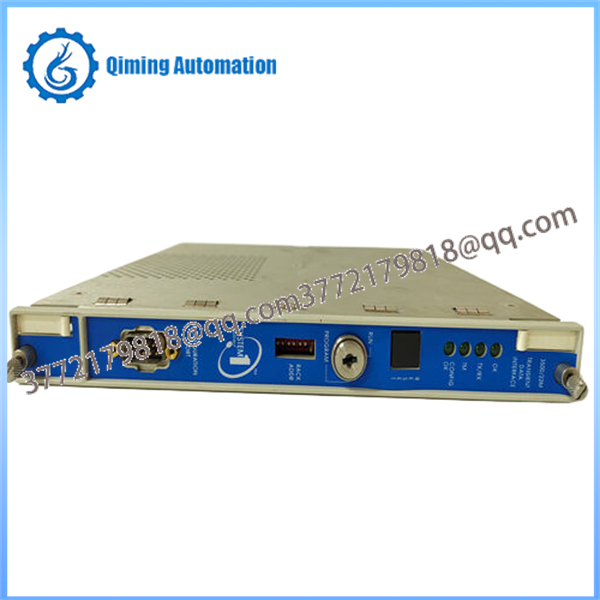
Bently Nevada 3500/93 135785-02C is a key display component of the Bently Nevada 3500 series vibration monitoring system, model 135785-02C (common variant 135785-02), designed specifically for industrial rotating equipment, providing intuitive status display and alarm indication.
_副本.jpg)
_副本.jpg)
There are still some products that have not been listed yet. For more information, please contact us. If the product model does not match the displayed picture, the actual model shall prevail. Please consult us for specific product images; We will arrange for the warehouse to take photos for confirmation. We have 76 shared warehouses worldwide, so it may take several hours to accurately respond to your message. We deeply apologize for any inconvenience caused to you. Of course, we will process your inquiry as soon as possible.
Bently Nevada 3500/93 135785-02C is a key display component of the Bently Nevada 3500 series vibration monitoring system, model 135785-02C (common variant 135785-02), designed specifically for industrial rotating equipment, providing intuitive status display and alarm indication.
As a backlight display unit, it is installed in a 3500 rack or remote location, supports API 670 standard, and is suitable for mechanical protection systems in industries such as power generation, petrochemicals, and oil and gas.
_副本.jpg "3500-93 135785-02C")
_副本.jpg "3500-93 135785-02C")
Real time display of vibration data and alarm status (OK/DANGER/ALARM) for each channel.
Supports local/remote installation and communicates with the rack through the Display Interface Module (DIM).
Backlight design facilitates reading in low light environments on-site, enhancing operational safety.
Commonly used in conjunction with 3500/40M monitors and 125680-01 I/O modules to achieve comprehensive device monitoring.
Brand Bently Nevada
Model 3500/93 135785-02C
Type System Display/Back lit Display Unit
Compatible System 3500 Rack Series
Install 19 inch EIA rack or remote
Standard API 670
Supply status: Original/refurbished, in stock
One year warranty (test report)
Widely used for on-site monitoring of rotating machinery such as turbines, compressors, and pumps, helping operators quickly respond to abnormalities and avoid equipment failures.
The CPU controller, also known as the central processing unit controller, is one of the core components of computer hardware, responsible for coordinating and managing various components of the computer, realizing functions such as computation, control, and storage.
Basic concepts of CPU controller
The CPU controller, also known as the Central Processing Unit Controller, is one of the core components of computer hardware. It is mainly composed of arithmetic logic unit (ALU), control unit (CU), register group, etc., responsible for executing instructions in computer programs, realizing functions such as computer operations, control, and storage.
Composition of CPU controller
The CPU controller mainly consists of the following parts:
(1) Arithmetic Logic Unit (ALU): responsible for performing arithmetic and logical operations such as addition, subtraction, multiplication, division, AND, OR, NOT, etc.
(2) Control Unit (CU): Responsible for parsing instructions, generating control signals, and controlling the operation of other components.
(3) Register group: including instruction registers, program counters, accumulators, etc., used to store instructions, program addresses, operation results, etc.
(4) Bus interface: responsible for exchanging data with external devices such as memory, input/output devices, etc.
(5) Clock circuit: Provides clock signals to control the working rhythm of the CPU.
The working principle of CPU controller
The working principle of a CPU controller mainly includes the following steps:
(1) Instruction retrieval: The CPU retrieves instructions from memory and places them in the instruction register.
(2) Instruction decoding: The control unit decodes instructions to determine the type and operand of the instruction.
(3) Execute instructions: Based on the instruction type and operand, the CPU performs corresponding operations, such as arithmetic operations, logical operations, data transfer, etc.
(4) Storage result: Store the execution result in a register or memory.
(5) Update program counter: Update the program counter to the address of the next instruction.
(6) Repeat the above steps until the program is fully executed.
Performance indicators of CPU controller
The performance indicators of CPU controllers mainly include the following aspects:
(1) Main frequency: The operating frequency of the CPU, measured in Hertz (Hz), representing the number of instructions that the CPU can execute per second.
(2) Core count: The number of processor cores inside a CPU. A multi-core CPU can execute multiple instructions simultaneously, improving computational efficiency.
(3) Cache: High speed memory inside the CPU, used to store commonly used instructions and data, reduce the number of memory accesses, and improve computing speed.
(4) Instruction set: The types and quantities of instructions supported by the CPU, which affect the computing power and compatibility of the CPU.
(5) Power consumption: The amount of electricity consumed by the CPU during operation, which affects the energy consumption and cooling requirements of the computer.
The Development History of CPU Controllers
The development process of CPU controllers can be divided into the following stages:
(1) Early CPUs, such as the Intel 4004, used a 4-bit data bus with a clock frequency of 740kHz and integrated 2300 transistors.
(2) 16 bit CPU: such as Intel 8086, using a 16 bit data bus, with a main frequency of 4.77MHz, and integrating 29000 transistors.
(3) 32-bit CPU: such as Intel 80386, using 32-bit data bus, with a main frequency of 12MHz, integrated with 275000 transistors.
(4) Superscalar CPU: such as Intel Pentium, which adopts superscalar architecture and can execute multiple instructions simultaneously, improving computational efficiency.
(5) Multi core CPU: such as Intel Core i7, which adopts a multi-core architecture and can execute multiple programs simultaneously, improving computing power.
(6) Heterogeneous computing: such as Intel Xeon Phi, which integrates CPU and GPU, can achieve heterogeneous computing and improve computing performance.
Application Fields of CPU Controllers
CPU controllers are widely used in various fields, such as:
(1) Personal computer: used to execute various applications such as office software, image processing, games, etc.
(2) Server: Used to handle a large number of network requests, provide web services, database services, etc.
(3) Embedded systems: used to control various devices such as smartphones, smart homes, automotive electronics, etc.
(4) High performance computing: used to perform complex scientific calculations such as weather forecasting, molecular simulations, etc.
(5) Artificial Intelligence: Used to execute deep learning, machine learning, and other algorithms to achieve intelligent recognition, natural language processing, and other functions.
The Development Trend of CPU Controllers
The development trend of CPU controllers mainly includes the following aspects:
(1) Higher frequency: With the advancement of process technology, the CPU's frequency will continue to increase, improving computing speed.
(2) More cores: Multi core CPUs will become mainstream, achieving higher parallel computing capabilities.
(3) Larger cache: With the improvement of CPU performance, cache capacity will continue to increase, improving data access speed.
(4) Lower power consumption: By optimizing design and process technology, CPU power consumption is reduced, achieving energy conservation and environmental protection.
(5) More intelligent control: Through artificial intelligence technology, CPU adaptive control is achieved to improve computing efficiency.
(6) Wider application: CPU controller will be used in more fields, such as Internet of Things, edge computing, etc.
Do you provide global shipping services?
Yes. We have local distribution centers on all continents, which can quickly transport parts to any corner of the world.
2. What payment methods and currencies do you accept?
To make your purchasing process as simple as possible, we offer multiple payment methods including bank transfer, check, and PayPal. Meanwhile, we also accept most mainstream credit and debit cards, such as Visa, Mastercard, and American Express. We can accept payments in most major currencies worldwide, but we recommend using US dollars (USD), British pounds (GBP), or euros (EUR) as a priority. Payments in other currencies may incur additional fees. All transactions are securely processed by HSBC Bank and HSBC Merchant Services.
How many parts do you currently have in stock?
We have a vast inventory of thousands of new, refurbished, and outdated automation components, including products from well-known manufacturers such as ABB and Schneider. If you cannot find the required parts, please do not worry. We work closely with a global network of professional suppliers to provide you with tailored quotes even if the part is not listed on our website.
Who can I contact if I encounter any problems?
Our experienced customer service team will handle any issues after you place your order.


 WhatsApp
 WeChat
Copyright © 2026 Guangzhou Qiming Automation Technology Co., Ltd


 TOP
TOP Home
Home Consult Now
 Back to list
_副本.jpg)
_副本.jpg)
_副本.jpg)
