





The ABB SCM-1 is a high-performance, dual-core industrial controller designed for complex automation applications across diverse industrial sectors. As a versatile component within ABB's System 800xA family, the SCM-1 provides powerful processing capabilities, extensive I/O flexibility, and multiple communication interfaces for demanding process control, machine automation, and building automation applications .
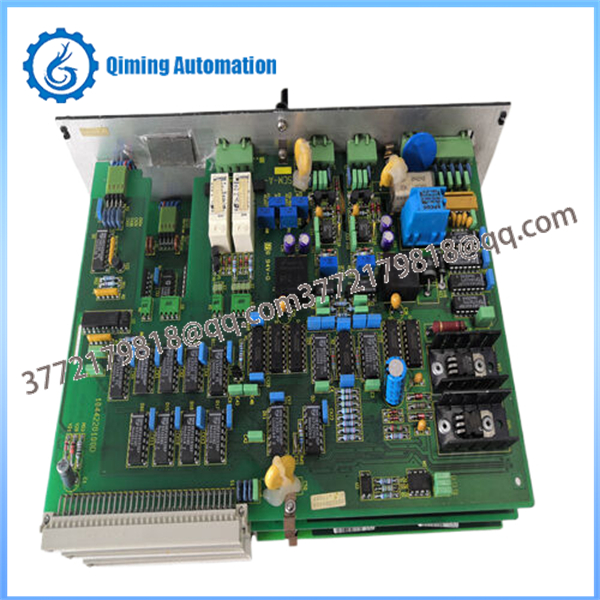
There are still some products that have not been listed yet. For more information, please contact us. If the product model does not match the displayed picture, the actual model shall prevail. Please consult us for specific product images; We will arrange for the warehouse to take photos for confirmation. We have 76 shared warehouses worldwide, so it may take several hours to accurately respond to your message. We deeply apologize for any inconvenience caused to you. Of course, we will process your inquiry as soon as possible.
The ABB SCM-1 is a high-performance, dual-core industrial controller designed for complex automation applications across diverse industrial sectors. As a versatile component within ABB's System 800xA family, the SCM-1 provides powerful processing capabilities, extensive I/O flexibility, and multiple communication interfaces for demanding process control, machine automation, and building automation applications .
The ABB SCM-1 serves as a central control unit in distributed control systems (DCS), programmable logic controllers (PLC), and industrial automation platforms. The SCM-1 is widely deployed in power generation, elevator systems, automotive manufacturing, steel production, chemical processing, water treatment, and building management systems requiring reliable, high-speed control and data processing .

Parameter | Specification |
Model Number | |
Product Type | High-Performance Industrial Controller |
Processor | Dual-core ARM Cortex-A9 |
Memory | 1 GB RAM, 4 GB Flash |
Operating System | Embedded Linux (industrial variant) |
Power Supply | 24 VDC |
Operating Temperature | -20°C to +60°C |
Communication Interfaces | Ethernet, RS-232, RS-485 |
I/O Support | Analog inputs/outputs, digital inputs/outputs, temperature sensors, specialty modules |
Mounting | DIN rail or panel mounting |
Protection Rating | IP20 (control cabinet installation) |
Certifications | CE, UL, IEC 61131-2, RoHS |
The SCM-1 offers extensive functionality for industrial automation:
Dual-Core Processing: ARM Cortex-A9 dual-core architecture enables simultaneous handling of multiple control tasks, complex algorithms, and real-time data processing with high efficiency
Flexible I/O Configuration: Supports wide range of I/O modules including analog inputs (4-20mA, 0-10V), analog outputs, digital inputs (24V DC), digital outputs (relay/transistor), temperature sensors (RTD, thermocouple), and specialty modules for motion control
Multiple Communication Protocols: Integrated Ethernet, RS-232, and RS-485 interfaces enable seamless connectivity to field devices, HMI panels, SCADA systems, and enterprise networks
System 800xA Integration: Native compatibility with ABB's System 800xA distributed control platform for unified automation and information management
Compact Design: Space-efficient form factor suitable for control cabinet installations with DIN rail mounting
Industrial Reliability: Designed for 24/7 operation in harsh industrial environments with extended temperature range and robust construction
Configuration Steps
Hardware Installation: Mount ABB SCM-1 on standard 35mm DIN rail or panel mount in clean, dry control cabinet environment
Power Connection: Connect 24V DC power supply to designated terminals observing correct polarity and proper grounding
I/O Module Configuration: Install and configure I/O modules based on application requirements—analog for process variables, digital for discrete control, temperature for thermal monitoring
Communication Setup: Configure Ethernet for SCADA/HMI integration, RS-485 for Modbus RTU field devices, and RS-232 for programming or serial devices
Programming: Develop control logic using IEC 61131-3 languages (Ladder Diagram, Function Block Diagram, Structured Text) in ABB Automation Builder or System 800xA engineering environment
System Integration: Integrate SCM-1 into System 800xA architecture for centralized monitoring, alarming, and historian functions
Daily Operation
Monitor SCM-1 status via integrated LEDs indicating power, run status, and communication activity
Access real-time data through web interface or dedicated HMI panels
Review diagnostic information including I/O states, communication statistics, and system health via System 800xA workplace
Execute control commands and adjust setpoints through operator interfaces
Pre-Installation Requirements
Verify SCM-1 model and I/O configuration match application requirements
Ensure control cabinet maintains -20°C to +60°C ambient temperature
Prepare 35mm DIN rail or panel mounting infrastructure
Confirm 24V DC power supply capacity adequate for controller and I/O modules
Plan communication topology: Ethernet for upper-level systems, RS-485 for field devices
Mechanical Mounting: Snap SCM-1 onto 35mm standard DIN rail ensuring secure retention and proper grounding through rail connection
Power Wiring: Connect 24V DC supply with appropriate wire sizing (minimum 0.75mm²) and fuse protection
I/O Wiring:
Analog inputs: Use shielded twisted-pair cables for 4-20mA or 0-10V signals
Digital inputs: Connect 24V DC field devices with proper surge protection
Digital outputs: Wire relay or transistor outputs to loads with appropriate contact protection
Communication Cabling:
Ethernet: Use CAT5e/CAT6 shielded cables for industrial environments
RS-485: Implement proper bus termination (120Ω) and shield grounding
RS-232: Use shielded cables for short-distance programming connections
Grounding: Ensure proper PE connection to control cabinet earth bar for safety and EMC compliance
Pre-Energization Checks
Verify all terminal connections for tightness and correct polarity
Check insulation resistance >100 MΩ at 500V DC per IEC standards
Confirm communication cable shield grounding at single point
Validate IP address configuration for Ethernet interface
Ensure I/O module seating and retention
Power-On Test: Apply 24V DC and verify power LED illuminates; observe boot sequence completion
Communication Verification:
Ping test Ethernet interface
Verify RS-485 communication with field devices using terminal emulator
Test Modbus register access or proprietary protocol communication
I/O Testing:
Force digital outputs and verify field device response
Inject 4-20mA signals to analog inputs and validate scaling
Test temperature inputs with known reference sources
Control Logic Validation: Execute test sequences to verify programmed functionality and interlocks
System Integration: Connect to System 800xA and verify data exchange, alarming, and historian functionality
Documentation: Record final configuration settings and create backup project file
Routine Inspection (Quarterly)
Inspect ABB SCM-1 for dust accumulation; clean with dry compressed air if necessary
Verify all LED indicators function correctly: Power (green), Run (steady/flashing), Error (red)
Check communication cable connections and terminal tightness
Review diagnostic logs for abnormal events or communication errors
Annual Maintenance
Perform firmware updates to access latest features, security patches, and protocol enhancements
Test all I/O channels for proper operation and calibration drift
Verify communication protocol performance and response times
Backup configuration and project files to external storage
Verify System 800xA integration and data exchange integrity
Long-Term Maintenance
5-Year Cycle: Replace electrolytic capacitors if operating in high-temperature environments
Memory Backup: Regularly backup Flash memory contents to prevent data loss
Battery Replacement: If equipped with real-time clock battery, replace every 5 years
Module Replacement: The SCM-1 supports configuration backup/restore for rapid module exchange
Condition Monitoring
The SCM-1 provides comprehensive diagnostics:
CPU load and memory utilization monitoring
I/O channel health diagnostics (wire break detection for analog inputs)
Communication link quality statistics (error counts, timeouts)
Temperature monitoring with overtemperature alarms
System event logging with timestamp


 WhatsApp
 WeChat
Copyright © 2026 Guangzhou Qiming Automation Technology Co., Ltd


 TOP
TOP Home
Home Consult Now
 Back to list
.jpg)
.jpg)
.jpg)
